A key principle from behavioural science is that behaviour change is sustained when it is specific, context-bound, and reinforced over time. General intentions (e.g., “I will manage stress better”) are significantly less effective than clearly defined, situationally anchored actions.
Research on implementation intentions (Gollwitzer, 1999) demonstrates that linking behaviour to a specific cue increases the likelihood of execution, while habit formation research (e.g., Wendy Wood) shows that repetition within stable contexts leads to automaticity.
In healthcare settings, where unpredictability and time pressure dominate, simplicity and realism are critical. Effective integration requires:
· Small, clearly defined behaviours
· Consistent environmental triggers
· Minimal tracking systems
· Built-in recovery support
1. One Habit to Build
A small, specific resilience behaviour integrated into workflow
Examples:
· Take one breath before responding
· Pause before entering a patient room
· Reframe one stressful thought
2. One Trigger (Cue)
A consistent moment in the work environment that activates the behaviour
Examples:
· After hand hygiene
· Before speaking in a meeting
· When finishing documentation
3. One Tracking Method
A simple way to reinforce consistency
Options:
· Checkbox (✔ / ✘)
· 1–5 scale
· End-of-shift reflection
Principle: Tracking should require minimal time and cognitive effort.
4. One Recovery-Support Action
A behaviour that protects energy and prevents depletion
Examples:
· Protecting one break during shift
· Setting a boundary on overtime
· Prioritizing sleep post-shift
Final Reflection: Strengthening Implementation
· “What will make this stick over the next 7 days?”
→ Identifies enabling conditions (routine, reminders, support)
· “What might get in the way—and how will I respond?”
→ Anticipates barriers and defines adaptive responses
Anticipating obstacles and planning responses increases follow-through and resilience under stress (Gollwitzer & Sheeran, 2006).
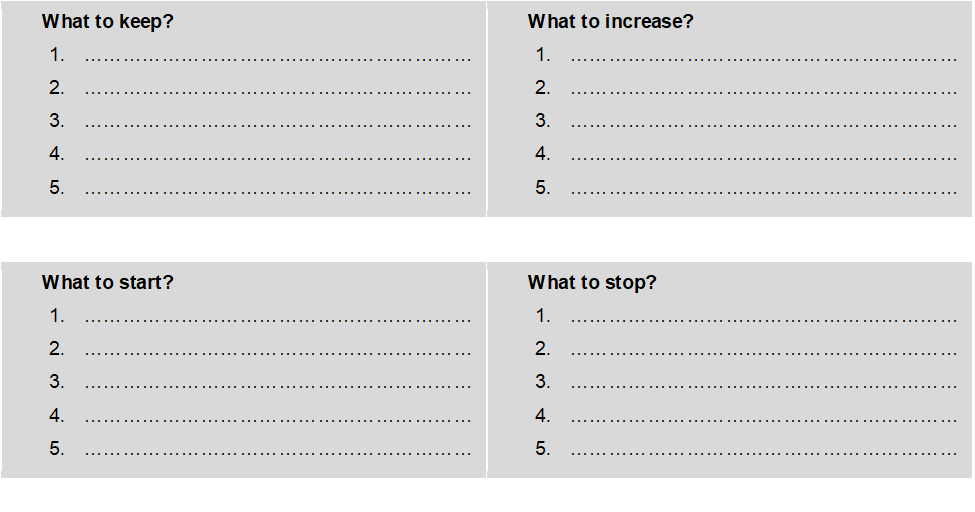
Create your personal action plan for better resilience at work answering the following questions: