Module 1: Understanding Burnout in Healthcare

- Description
- Curriculum
- Reviews
Module Overview
Burnout in healthcare is not a personal failing—it is a syndrome conceptualized as resulting from chronic workplace stress that has not been successfully managed [7, 8]. This evidence-based foundational module equips healthcare professionals to recognize burnout as a structural and relational phenomenon that emerges at the intersection of individual limits, role demands, and organizational context.
Participants will move beyond the misconception that burnout stems from poor coping mechanisms or personal weakness. Instead, they will explore how emotional labor, moral distress, decision fatigue, shift work disruption, and administrative burden create predictable patterns of exhaustion across different healthcare roles. By understanding the neurophysiology of chronic stress, the progressive phases of burnout development, and the distinction between related occupational syndromes, participants gain the conceptual foundation needed for early detection and meaningful intervention—both personally and systemically.
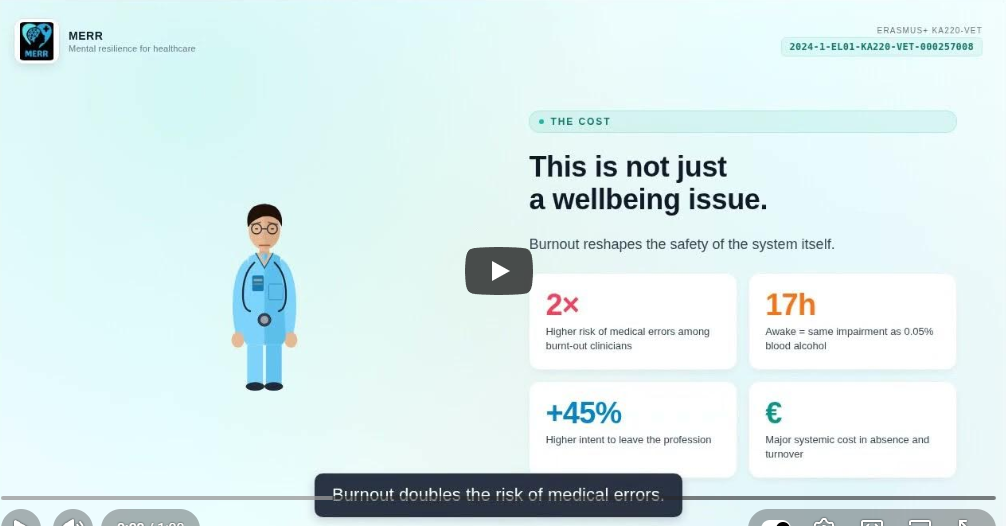
This module serves as the cornerstone for a comprehensive resilience framework that acknowledges burnout prevention is patient safety, and addressing burnout is an organizational responsibility requiring evidence-based interventions.
Module Delivery Specifications
• Duration: 90-120 minutes (adaptable to two 60-minute sessions)
• Format: Interactive workshop combining didactic content, case analysis, self-reflection, and peer discussion
• Materials: Self-assessment worksheets, role-specific mapping templates, case scenario packets, micro-reset practice guides
• Follow-up Integration: Monthly check-in reminders, anonymous screening access, peer support connections.
Duration
– 15–20 min – Module overview, learning objectives, executive summary
– 30–40 min – Core theoretical frameworks (JD-R, COR, Transactional Model)
– 20–30 min – Core concepts (burnout vs chronic stress vs compassion fatigue, Yerkes-Dodson, phases)
– 15–20 min – Case discussion + competency assessment
– 10–15 min – Reflection, implementation commitments, wrap-up
-
2
 Lesson 1: Comprehensive Theoretical Framework: Multi-Level Analysis of Healthcare Burnout
Understanding healthcare burnout requires integration of multiple theoretical perspectives operating at different levels of analysis. No single theoretical framework adequately captures the full complexity of how individual psychological processes, interpersonal dynamics, organizational structures, and societal forces interact to produce burnout syndrome. This section presents three major theoretical frameworks that collectively provide comprehensive understanding of burnout etiology, development, and intervention approaches.
-
3
Core Concepts: Four Foundational Elements
-
4
 Assessment 1Assessment and Implementation Framework This module requires practical application through structured assessment activities. Participants must demonstrate competency through evidence-based evaluation methods that translate knowledge into actionable interventions.
 -
5
Pilot Assessment
During the pilot sessions, the five learning outcomes are assessed through a blended portfolio of practical methods rather than a single examination. Each method below specifies the activity participants complete, how it is facilitated, and the evidence a trainer collects for the micro-credential portfolio. Methods are mapped directly to the module’s learning outcomes so that assessment, content, and credit remain aligned.