Module 7: Cognitive and Physiological Foundations of Doctor Wellbeing in High-Demand Care

- Description
- Curriculum
- Reviews
Module Overview
Doctors operate at the intersection of cognitive demand, physiological stress, and the fairness perceptions that emerge from team and organisational structures. Long shifts, on-call duty, decision-pressured cases, and hierarchical workflows all converge on the same physiological and cognitive systems — and when those systems are pushed beyond their recovery capacity, both doctor wellbeing and patient safety degrade together.
Where Module 1 established the foundational theoretical landscape of burnout — its diagnostic criteria, phases, and contributing systems — Module 2 turns to the proximal, day-to-day mechanisms that decide whether a doctor’s working life produces sustainable performance or accelerates toward harm. The module covers the physiology of long shifts, cognitive appraisal during high-pressure decisions, the role of fairness in clinical teams, fatigue risk thresholds and escalation routes, the boundary and switching work that protects cognition, the basics of on-call recovery, and how primary prevention can be embedded in everyday team practice.
This module is targeted specifically at doctors. It addresses the patterns of decision pressure, autonomy expectations, on-call cycles, and fairness sensitivity that characterise medical work in particular. Participants leave with the operational vocabulary and the early-warning instincts to act on stress, fatigue, and unfairness before they convert into clinical error or career attrition.
Module Delivery Specifications
• Duration: 120–150 minutes (adaptable to two 75-minute sessions).
• Format: interactive workshop combining didactic teaching, case-based reasoning, reappraisal drill, peer discussion, and individual planning.
• Materials: fatigue-and-boundary self-audit, fairness mapping worksheet, escalation-phrase rehearsal cards, on-call recovery protocol, prevention-initiative template, the case study packet.
• Follow-up Integration: four-cycle portfolio with supervisor sign-off; 90-day prevention-initiative review; quarterly peer-debrief check-ins.
Duration
• 15–20 min — Module overview, learning outcomes, executive summary
• 25–30 min — Theoretical frameworks (Allostatic Load, Cognitive Appraisal, Organisational Justice)
• 30–40 min — Core concepts (long-shift physiology, appraisal, fairness, fatigue/escalation, boundaries/switching, on-call recovery, primary prevention)
• 20–25 min — Case study analysis and group discussion
• 15–20 min — Multiple-choice assessment + answer review
• 10–15 min — Reflection, prevention-initiative commitment, wrap-up
-
2
 Lesson 1: Comprehensive Theoretical Framework: Three Converging Models
Operational physician resilience cannot be explained by a single theory. Three frameworks operating at different levels — physiological, cognitive, and organisational — collectively account for the phenomena addressed in this module. Each is presented with its core premise, its mechanism, and its direct relevance for doctors.
-
3
Lesson 2: Core Concepts: Seven Foundational Elements
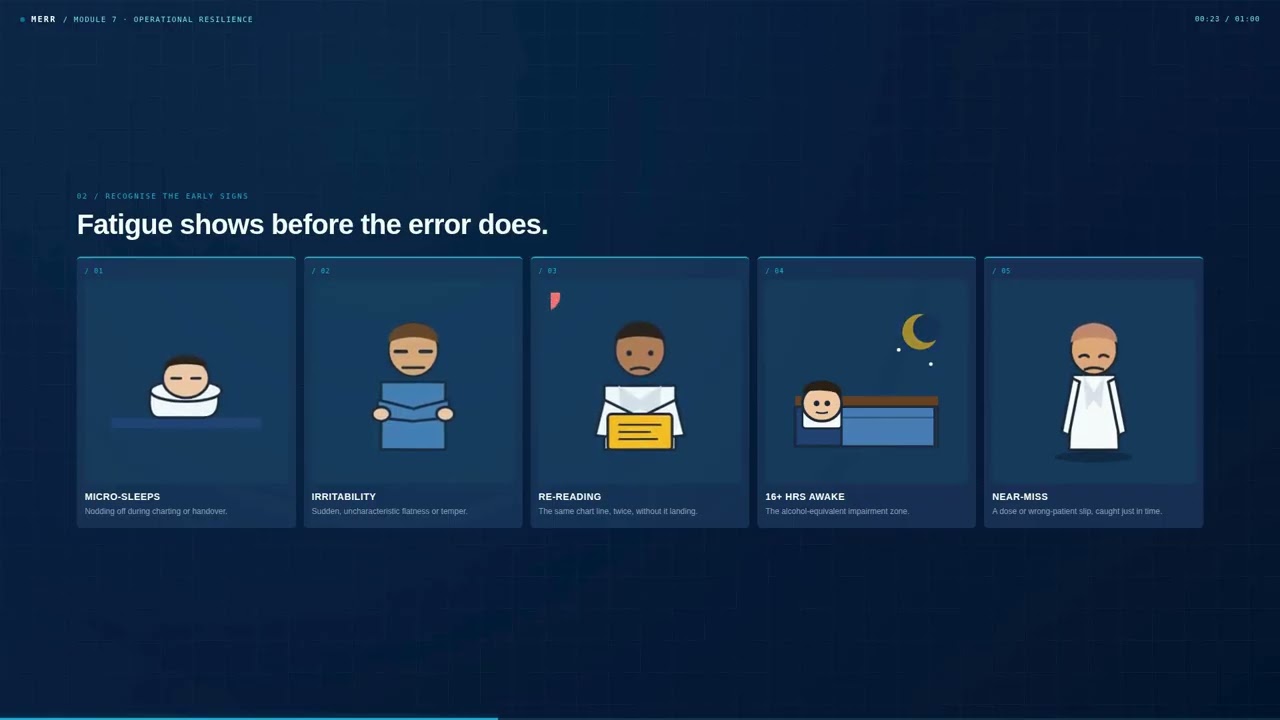
Long shifts produce a stereotyped physiological signature in doctors: an early adrenergic surge that supports alertness, a mid-shift plateau under cortisol drive, and a late-shift decline as energy substrates and prefrontal capacity drop. Across the night, circadian misalignment compounds these effects — the same task is harder, slower, and more error-prone at 04:00 than at 14:00, regardless of how rested the doctor is.
-
4
 Quiz Module 7This module requires practical application through structured assessment activities. Doctors must demonstrate competency through evidence-based evaluation methods that translate operational knowledge into safe clinical behaviour.
 -
5
Pilot Assessment
During the pilot sessions, the six learning outcomes are assessed through a blended portfolio of practical methods rather than a single examination. Each method below specifies the activity doctors complete, the evidence a trainer collects for the micro-credential portfolio, and the learning outcome it maps to, so that assessment, content, and credit stay aligned.