
Administrative staff in healthcare systems occupy a structurally complex role. They function as intermediaries between patients, healthcare professionals, insurance providers, and institutional systems. As the first point of contact in many healthcare encounters, front-desk personnel are frequently exposed to emotional, operational, and organisational pressures.
Research in occupational health psychology demonstrates that service-oriented administrative roles in healthcare experience high levels of emotional labour, cognitive workload, and exposure to conflict [1, 10]. These factors are relevant predictors of occupational stress and burnout.
This module therefore approaches administrative well-being not as an individual responsibility alone, but as a combination of practical skills, policy clarity, supportive leadership, and manageable digital workflows.
Structural stressors arise from systemic characteristics of healthcare organisations rather than individual performance. Common examples include:
• High patient volumes and scheduling pressure
• Administrative complexity related to insurance systems
• Staffing shortages
• Digital system interruptions
• Limited decision-making authority
According to the Job Demands-Resources (JD-R) model[1], burnout develops when job demands consistently exceed available resources such as autonomy, support, or role clarity [2]. Administrative staff often face high demands but limited control over workflow decisions, which can increase vulnerability to emotional exhaustion.
Administrative staff in healthcare settings operate within a highly dynamic environment in which competing demands frequently occur simultaneously. Unlike many other administrative professions, healthcare reception and coordination roles combine customer service functions, documentation responsibilities, scheduling tasks, and emotionally sensitive interactions. Employees must continuously balance efficiency requirements with patient-centred communication while maintaining professionalism under time pressure.
One important characteristic of front-desk work is role ambiguity. Administrative personnel are often expected to solve problems or provide information while having limited authority to make decisions regarding clinical matters, treatment priorities, or resource allocation. Patients may nevertheless perceive front-desk staff as representatives of the entire organisation and direct frustration toward them when expectations cannot be met.
Healthcare organisations frequently operate under conditions of uncertainty. Appointment schedules may change unexpectedly, emergency cases can disrupt planned workflows, and staffing shortages may require employees to take on additional responsibilities. Such unpredictability increases cognitive workload because staff must constantly adapt their priorities and redirect their attention between competing tasks.
Another source of strain stems from the emotional context of healthcare itself. Administrative employees regularly encounter individuals who are worried about their health, concerned about family members, or experiencing pain and distress. Even when administrative staff are not directly involved in clinical care, they may absorb emotional tension through repeated exposure to these situations. Over time, this phenomenon may contribute to compassion fatigue and emotional exhaustion.
Research suggests that stress exposure is particularly high when employees experience a combination of high workload, low control, and insufficient social support. Consequently, healthcare organisations should view front-desk stressors not as isolated individual challenges but as predictable occupational risks requiring systematic prevention measures.
Front-desk roles require substantial emotional labour, defined as the regulation of emotional expressions to meet professional expectations [4, 5]. Employees must frequently maintain a calm and supportive demeanor even in situations involving frustration, distress, or hostility from patients or relatives.
Healthcare administrative staff may be required to communicate delays or cancellations, enforce institutional policies, handle complaints and grievances, and manage emotionally distressed patients. Sustained emotional dissonance can contribute to burnout and emotional fatigue.
Front desks are typically characterized by high interruption frequency, including:
• Phone calls
• Walk-in patient inquiries
• Internal staff requests
• Digital system alerts
Frequent interruptions lead to cognitive switching costs, which impair concentration and increase the likelihood of errors. Interruption-heavy environments can elevate perceived stress and reduce task efficiency.
Administrative staff are often the first recipients of frustration related to healthcare system delays or constraints. Exposure may include verbal hostility, threats, attempts at coercion, and emotional escalation. Without institutional support mechanisms, repeated exposure to aggression can contribute to burnout, withdrawal behaviour, and decreased job satisfaction [1, 11].
Practice Vignette: Multiple Competing Demands at the Reception Desk
Maria works at the reception desk of a large outpatient clinic. During a busy Monday morning, she is simultaneously answering phone calls, checking in patients, updating insurance information, and responding to requests from clinical staff. A patient becomes visibly frustrated after learning that their appointment must be rescheduled due to a physician’s absence. At the same time, multiple digital notifications appear on Maria’s screen requesting documentation updates and scheduling confirmations.
Although Maria remains professional, she notices increasing tension and difficulty concentrating. She feels responsible for solving problems that are beyond her authority and worries that mistakes may occur because of the constant interruptions.
This example illustrates how structural, relational, and digital stressors often occur simultaneously in healthcare administration.
Reflection Question
Which stressors in Maria’s situation are structural, relational/emotional, and digital? Which could realistically be changed by the organisation?
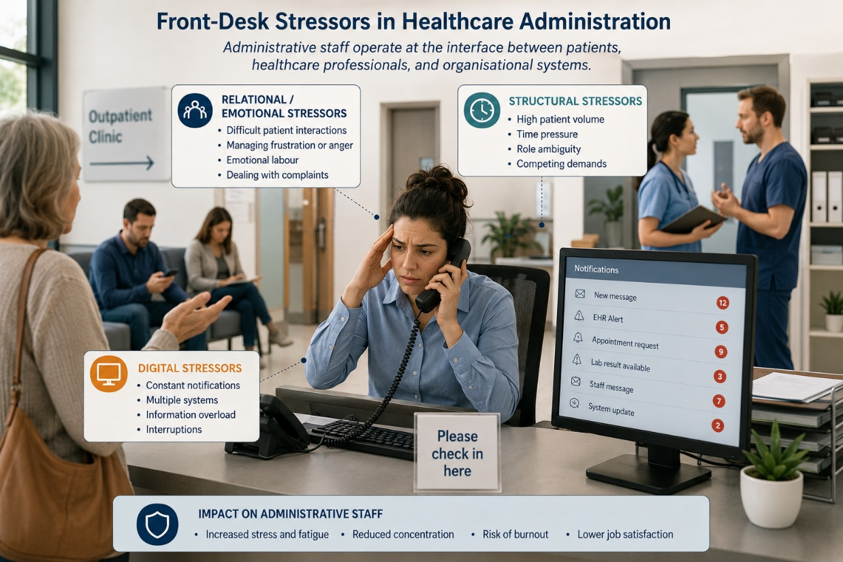
Figure SEQ Figure \* ARABIC 1: Source: AI-generated illustrative image (for training purposes only)
Primary prevention refers to proactive strategies aimed at preventing stress and burnout before symptoms emerge. In healthcare service roles, primary prevention must combine organisational structures and individual coping skills.
Primary prevention is most effective when it addresses both the working environment and the capabilities of employees. Contemporary occupational health research emphasizes that burnout prevention should begin long before employees show signs of distress. Waiting until symptoms emerge often results in higher organisational costs, reduced productivity, increased absenteeism, and staff turnover.
At the organisational level, prevention starts with work design. Clear responsibilities, realistic workload expectations, and adequate staffing are among the strongest protective factors against chronic stress. Equally important is role clarity. Employees who understand what is expected of them and where the boundaries of their responsibilities lie are better able to manage difficult interactions and maintain psychological well-being.
Leadership plays a central role in primary prevention. Supervisors influence organisational culture through communication, feedback, and support practices. Employees who perceive their supervisors as approachable and supportive report lower levels of stress and higher levels of work engagement. Regular team meetings, opportunities to discuss challenging situations, and constructive feedback processes can strengthen resilience at the team level.
Effective primary prevention strategies at the organisational level include clear role definitions, predictable escalation procedures, adequate staffing levels, clear communication channels, and supportive leadership culture. organisational climate and leadership behaviour are among the strongest predictors of employee well-being in healthcare environments.
While structural interventions are essential, individual coping skills can also mitigate stress exposure. Evidence-based strategies include:
• Emotional regulation techniques
• Cognitive reframing
• Boundary-setting communication
• Structured recovery breaks
Boundary-setting communication means responding to requests or pressure in a clear, respectful, and professional manner while maintaining the limits of one’s role and responsibilities. Such responses validate the other person’s concern while clearly communicating procedural limits.
Cognitive reframing can help employees interpret challenging situations in a more balanced way. For example, an angry patient may not necessarily be reacting personally to an employee but rather expressing frustration with circumstances that feel uncontrollable. Recognizing this distinction can help staff maintain professional distance while remaining empathetic.
The objective of individual prevention is not to eliminate stress entirely, which would be unrealistic in healthcare environments, but rather to strengthen employees’ ability to respond effectively to stressors while preserving their psychological resources. When combined with supportive organisational structures, individual coping skills can contribute significantly to long-term well-being and professional sustainability.
Short recovery periods throughout the workday help regulate physiological stress responses [15]. Even brief breaks can support concentration and emotional regulation. Examples include breathing exercises, posture changes, visual detachment from digital screens, and short walking breaks.
Digital technologies have increased administrative efficiency but also created new forms of occupational stress. Frequent digital notifications can trigger continuous partial attention, increase perceived time pressure, contribute to cognitive fatigue, and reduce productivity.
The increasing digitalization of healthcare administration has fundamentally transformed communication processes. Electronic health records, appointment systems, internal messaging platforms, emails, and mobile communication tools have improved efficiency but also introduced new cognitive demands.
Research on digital work environments suggests that excessive digital interruptions can impair concentration and contribute to mental fatigue [7, 17]. Each interruption requires employees to disengage from one task and redirect attention to another. This process, often referred to as task switching, consumes cognitive resources and can increase the likelihood of mistakes.
Notification overload can also create a perception of constant urgency. When employees receive continuous alerts throughout the day, they may feel compelled to respond immediately even when no immediate action is required. Over time, this can contribute to chronic stress, reduced job satisfaction, and a diminished sense of control over work.
Notification hygiene refers to structured management of digital alerts and communication channels. Recommended practices include disabling non-essential notifications, batching email responses, defining urgent communication channels, reducing redundant messaging platforms, and establishing clear response expectations [16, 9].
organisations can support notification hygiene by establishing communication protocols. Different communication channels may be assigned different levels of urgency. Routine information can be communicated via email, whereas urgent patient-related issues may require direct phone contact or designated emergency channels.
Employees can further support digital well-being by scheduling dedicated times for email processing, limiting non-essential notifications, and protecting focus periods for tasks that require concentration. Such practices improve attentional control and help reduce unnecessary cognitive strain.
Ultimately, notification hygiene should be viewed not only as a productivity strategy but also as a workplace health intervention that supports psychological well-being in increasingly digital healthcare environments.
Practice Vignette: Notification Overload
Lisa receives dozens of digital alerts each hour from appointment software, internal messaging systems, email notifications, and electronic health records. Although many notifications are not urgent, she feels compelled to check each one immediately. By the end of the day, she reports feeling mentally exhausted despite completing relatively few complex tasks.
After reviewing her notification settings, Lisa disables non-essential alerts and establishes dedicated times for checking email. Within several weeks she notices fewer interruptions and improved concentration.
Reflection Question
Which notifications in your workplace are truly urgent, and which could be processed in scheduled batches?
Clear procedural knowledge improves both staff confidence and patient safety outcomes.
Policy literacy refers to the ability to understand, interpret, and apply organisational rules and procedures in everyday work situations. For healthcare administrative staff, policy literacy is particularly important because many interactions involve sensitive personal information, legal requirements, and patient rights.
Employees who possess strong policy knowledge often report greater confidence when dealing with challenging situations. Rather than relying solely on personal judgement, they can refer to established procedures and organisational standards. This reduces uncertainty and promotes consistency in service delivery.
Administrative staff must operate within legal and organisational frameworks governing healthcare communication and documentation. Important policy areas include patient confidentiality, documentation obligations, consent and disclosure rules, and data protection standards.
Administrative staff working in healthcare settings have the fundamental right to a safe and respectful work environment.
Healthcare organisations have a duty of care toward their staff and should provide clear reporting procedures, access to supervisory support, and protection mechanisms for employees who experience aggression or harassment.
A practical escalation framework may consist of several stages:
Stage 1 – Clarification: The employee calmly explains procedures and attempts to resolve misunderstandings.
Stage 2 – Boundary Setting: Clear expectations regarding respectful communication are communicated.
Stage 3 – Support Activation: A supervisor or designated colleague becomes involved.
Stage 4 – Safety Measures: Security procedures or emergency protocols are activated when necessary.
Such frameworks reduce ambiguity and ensure that employees do not feel solely responsible for managing highly stressful encounters.
Sustainable well-being requires improvements in the interaction between workers and their work environment rather than relying solely on individual resilience.
Historically, discussions about burnout often focused primarily on individual resilience and personal coping strategies. While these approaches remain valuable, contemporary occupational health research increasingly emphasizes the interaction between employees and their work environment.
Burnout rarely develops because of a single factor. Instead, it typically emerges from prolonged exposure to an imbalance between demands and available resources [8, 10]. Sustainable prevention therefore requires interventions at multiple levels simultaneously.
Individual strategies such as stress management, emotional regulation, recovery practices, and communication skills help employees maintain personal resources [13, 15]. However, these efforts can only achieve limited success if organisational conditions remain problematic. Excessive workload, chronic understaffing, unclear responsibilities, or poor leadership cannot be solved through resilience training alone.
Likewise, organisational interventions are most effective when employees possess the skills and confidence necessary to make use of available resources. Supportive leadership, clear procedures, and healthy digital communication practices create conditions in which individual coping strategies can succeed.
This integrated perspective is consistent with contemporary occupational health frameworks, including the Job Demands-Resources model, which emphasizes the importance of balancing demands with adequate resources. Effective healthcare organisations therefore invest not only in employee training but also in organisational systems that support well-being, psychological safety, and sustainable performance. [2, 6]
Administrative healthcare staff play a critical role in the functioning of healthcare systems. Their interactions influence patient experience, institutional reputation, and operational efficiency. Effective burnout prevention requires a multidimensional approach that integrates:
• Awareness of front-desk stressors
• Proactive prevention strategies
• Responsible digital communication practices
• Policy literacy
• Structured escalation mechanisms
By strengthening both individual competencies and organisational support structures, healthcare institutions can foster resilience and sustainable work environments for administrative staff.
[1] As discussed in greater detail in module 1: “Understanding Burnout in Healthcare Professionals.”

