Start off Video: https://www.youtube.com/watch?v=8uZNGWPpdms
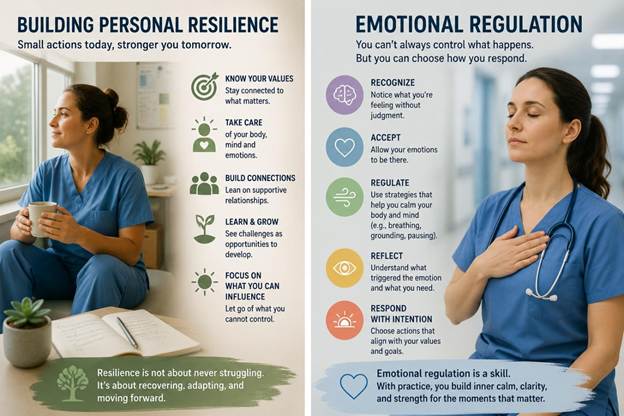
Healthcare professionals operate in environments characterized by sustained cognitive demand, emotional intensity, ethical complexity, and structural constraints. Research consistently demonstrates elevated levels of occupational stress and burnout across healthcare roles (WHO, 2019; OECD/European Commission, 2024). While Module 1 addressed the conceptualization and phases of burnout, the present module focuses on the protective mechanisms that mitigate its development: personal resilience and emotional regulation.
Resilience in this context is defined not as resistance to stress, but as adaptive recovery capacity — the ability to maintain psychological flexibility, regulate emotional responses, and restore equilibrium following demanding situations (Southwick et al., 2014). It is increasingly understood as a dynamic process shaped by individual skills and environmental factors rather than a fixed personality trait.
AI-generated image created with ChatGPT/OpenAI, 2026
Emotional regulation refers to the processes by which individuals influence the intensity, duration, and expression of their emotional responses (Gross, 1998; Gross, 2015). In healthcare settings, where professionals are frequently exposed to suffering, uncertainty, and high responsibility, effective emotional regulation is essential for maintaining both performance and wellbeing.
Under acute stress, the autonomic nervous system activates the sympathetic “fight-or-flight” response. While adaptive in emergency situations, prolonged activation leads to physiological dysregulation, impaired cognitive flexibility, increased irritability, and diminished empathic capacity (McEwen, 2017). Chronic activation without adequate recovery contributes to emotional exhaustion — the central component of burnout (Maslach & Leiter, 2016).
Emotional regulation strategies function by restoring balance between limbic reactivity (e.g., amygdala activation) and prefrontal control processes. When regulation skills are consistently practiced, they reduce cumulative stress load and protect against emotional depletion.
AI-generated image created with ChatGPT/OpenAI, 2026
One of the most direct ways to influence stress activation is through controlled breathing. Slow, structured breathing patterns stimulate parasympathetic activation via vagal pathways, thereby reducing heart rate and muscular tension (Porges, 2011).
For example, a brief 90-second breathing exercise can be implemented during clinical routines. The procedure involves inhaling slowly for four seconds, holding the breath for four seconds, and exhaling for six seconds, while consciously relaxing the shoulders. Extending the exhalation activates parasympathetic responses and signals physiological safety. When used between patient interactions or prior to high-stakes communication, this technique facilitates cognitive clarity and emotional stabilization.
Importantly, resilience is strengthened through repeated short interventions rather than infrequent extended recovery periods. Research on stress adaptation suggests that micro-recovery practices embedded in daily routines are more sustainable and effective in high-demand professions (Sonnentag & Fritz, 2015).
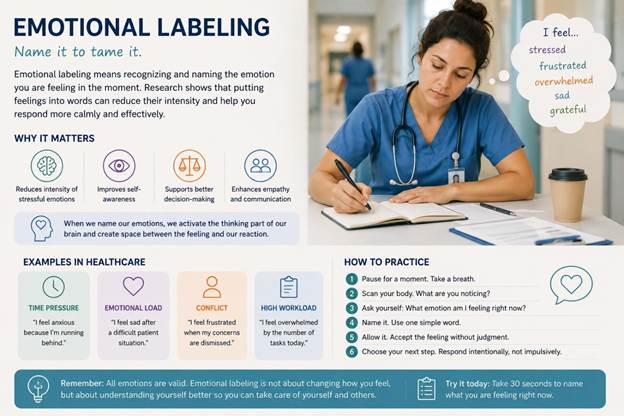
Healthcare professionals frequently rely on emotional suppression as a means of maintaining functionality. However, suppression is associated with increased physiological strain and diminished interpersonal effectiveness (Gross, 2015). In contrast, emotional labeling — the deliberate identification and naming of one’s emotional state — has been shown to reduce amygdala activation and enhance regulatory control (Lieberman et al., 2007).
In practice, this involves briefly identifying an internal state (e.g., “I feel overwhelmed” or “I feel frustrated”) rather than ignoring it. Such labeling requires minimal time but interrupts automatic reactivity and supports reflective processing.
Cognitive regulation also plays a central role in resilience. Under chronic stress, cognitive distortions such as catastrophizing or excessive responsibility attribution may emerge. Reframing techniques that distinguish between controllable and uncontrollable factors enhance psychological flexibility and reduce moral distress. This aligns with models of stress appraisal, which emphasize that perceived controllability significantly influences stress outcomes (Lazarus & Folkman, 1984).
Empirical research identifies workload and limited job control as major predictors of burnout in healthcare (Karasek & Theorell, 1990; Van der Doef & Maes, 1999). While structural reforms are essential, individual boundary-setting behaviors contribute to reducing emotional overload.
Assertive communication strategies allow professionals to articulate limits while maintaining collegial and patient-centered goals. For instance, clearly stating that cognitive capacity has been reached in the interest of patient safety reframes boundary-setting as a professional responsibility rather than personal refusal.

AI-generated image created with ChatGPT/OpenAI, 2026
Over time, consistent boundary management reduces anticipatory stress and protects empathic engagement. It also aligns with findings that autonomy and perceived control buffer the effects of high job demands (Karasek & Theorell, 1990)
Resilience does not develop through isolated interventions. It requires consistent implementation of small regulatory behaviors over time. Longitudinal research on stress adaptation indicates that repeated regulation practices strengthen neural pathways associated with emotional control and adaptive coping (McEwen, 2017).
In practical terms, this may include:
● Brief breathing resets during shifts
● Structured end-of-day decompression routines
● Consistent emotional labeling
● Scheduled digital disengagement
● Weekly reflective check-ins
Such practices gradually increase recovery capacity and reduce cumulative strain.
AI-generated image created with ChatGPT/OpenAI, 2026
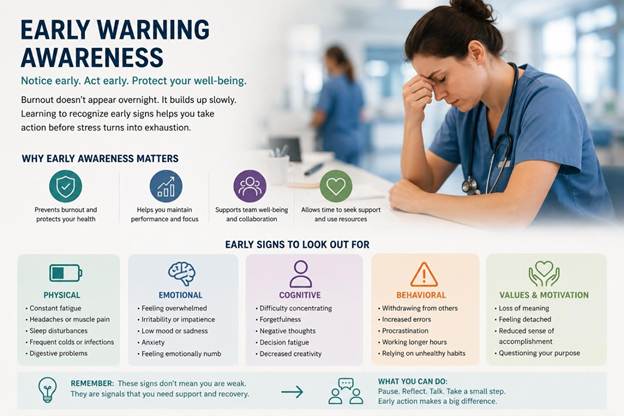
Early warning signals such as increased irritability, reduced empathy, sleep disturbance, or persistent rumination should be interpreted as indicators of insufficient recovery rather than personal inadequacy. Early intervention is significantly more effective than attempting recovery during advanced exhaustion phases (Maslach & Leiter, 2016).
The development of a personal “stress signature” – identifying one’s earliest physiological, emotional, and behavioral indicators – enhances preventive action. Self-assessment tools and structured reflection support this awareness and align with preventive occupational health approaches.
It is essential to emphasize that personal resilience does not replace organizational responsibility. Structural contributors such as workload intensity, limited staffing, and role ambiguity significantly influence stress levels (OECD/European Commission, 2024). However, emotional regulation enhances adaptive functioning within existing constraints and strengthens professionals’ capacity to engage constructively in systemic improvement efforts.
A balanced resilience framework therefore combines:
● Individual regulation skills
● Boundary competence
● Recovery practices
● Structural awareness
● Collective support mechanisms
This integrated perspective prevents the individualization of systemic strain while empowering healthcare professionals with practical, evidence-informed tools.
This module requires practical application through structured assessment activities. Healthcare professionals must demonstrate competency through evidence-based evaluation methods that translate theoretical knowledge into protective practice.
● Knowledge Assessment: Pass rate ≥ 50% on written examinations.
● Skills Assessment: Demonstrate proficiency ≥ 50% on performance-based assessments (pilot sessions).
● Competence Assessment: Achieve ≥ 50% on case analysis and scenario-based portfolio tasks.
Upon successful completion of all assessments, participants receive a verified micro-credential certificate in “Building Personal Resilience & Emotional Regulation” recognised for continuing professional development across EU healthcare systems.
Gross, J. J. (1998). The emerging field of emotion regulation: An integrative review. Review of General Psychology, 2(3), 271–299. The Emerging Field of Emotion Regulation: An Integrative Review – James J. Gross, 1998
Gross, J. J. (2015). Emotion regulation: Current status and future prospects. Psychological Inquiry, 26(1), 1–26. Emotion Regulation: Current Status and Future Prospects: Psychological Inquiry: Vol 26 , No 1 – Get Access
Karasek, R. A., & Theorell, T. (1990). Healthy work: Stress, productivity, and the reconstruction of working life. Basic Books.
Lazarus, R. S., & Folkman, S. (1984). Stress, appraisal, and coping. Springer.
Lieberman, M. D., Eisenberger, N. I., Crockett, M. J., Tom, S. M., Pfeifer, J. H., & Way, B. M. (2007). Putting feelings into words: Affect labeling disrupts amygdala activity in response to affective stimuli. Psychological Science, 18(5), 421–428. Putting Feelings Into Words – Matthew D. Lieberman, Naomi I. Eisenberger, Molly J. Crockett, Sabrina M. Tom, Jennifer H. Pfeifer, Baldwin M. Way, 2007
Maslach, C., & Leiter, M. P. (2016). Burnout. In G. Fink (Ed.), Stress: Concepts, cognition, emotion, and behavior (pp. 351–357). Academic Press. Burnout – ScienceDirect
McEwen, B. S. (2017). Neurobiological and systemic effects of chronic stress. Chronic Stress, 1, 1–11. https://doi.org/10.1177/2470547017692328
OECD/European Commission. (2024). Health at a glance: Europe 2024 – State of health in the EU cycle. OECD Publishing.
Porges, S. W. (2011). The polyvagal theory: Neurophysiological foundations of emotions, attachment, communication, and self-regulation. W. W. Norton.
Sonnentag, S., & Fritz, C. (2015). Recovery from job stress: The stressor–detachment model as an integrative framework. Journal of Organizational Behavior, 36(S1), S72–S103. https://onlinelibrary.wiley.com/doi/10.1002/job.1924
Van der Doef, M., & Maes, S. (1999). The job demand–control (–support) model and psychological well-being: A review of 20 years of empirical research. Work & Stress, 13(2), 87–114. The Job Demand-Control (-Support) Model and psychological well-being: A review of 20 years of empirical research: Work & Stress: Vol 13, No 2
World Health Organization. (2019). Burn-out an “occupational phenomenon”: International classification of diseases. https://www.who.int


