Module 2: Building Personal Resilience & Emotional Regulation

- Description
- Curriculum
- Reviews
Personal Resilience & Emotional Regulation Domain Description
Personal resilience and emotional regulation in healthcare imply the dynamic processes by which professionals maintain psychological flexibility, regulate emotional responses, and restore balance following demanding clinical situations. The area includes the neurophysiology of stress activation and recovery, evidence-based emotional regulation strategies, early warning sign recognition, assertive boundary communication, micro-recovery practices, and the development of personalised self-care plans realistic within high-demand healthcare schedules.
Healthcare professionals operate in emotionally demanding and structurally pressured environments. Chronic stress, emotional labor, and limited recovery time increase the risk of burnout, compassion fatigue, and emotional detachment.
This module introduces participants to the mechanisms of stress and burnout using the three-phase burnout model (alarm–resistance–exhaustion). Participants learn to identify structural, emotional, and organizational contributors to overload and distinguish between healthy stress and harmful chronic strain.
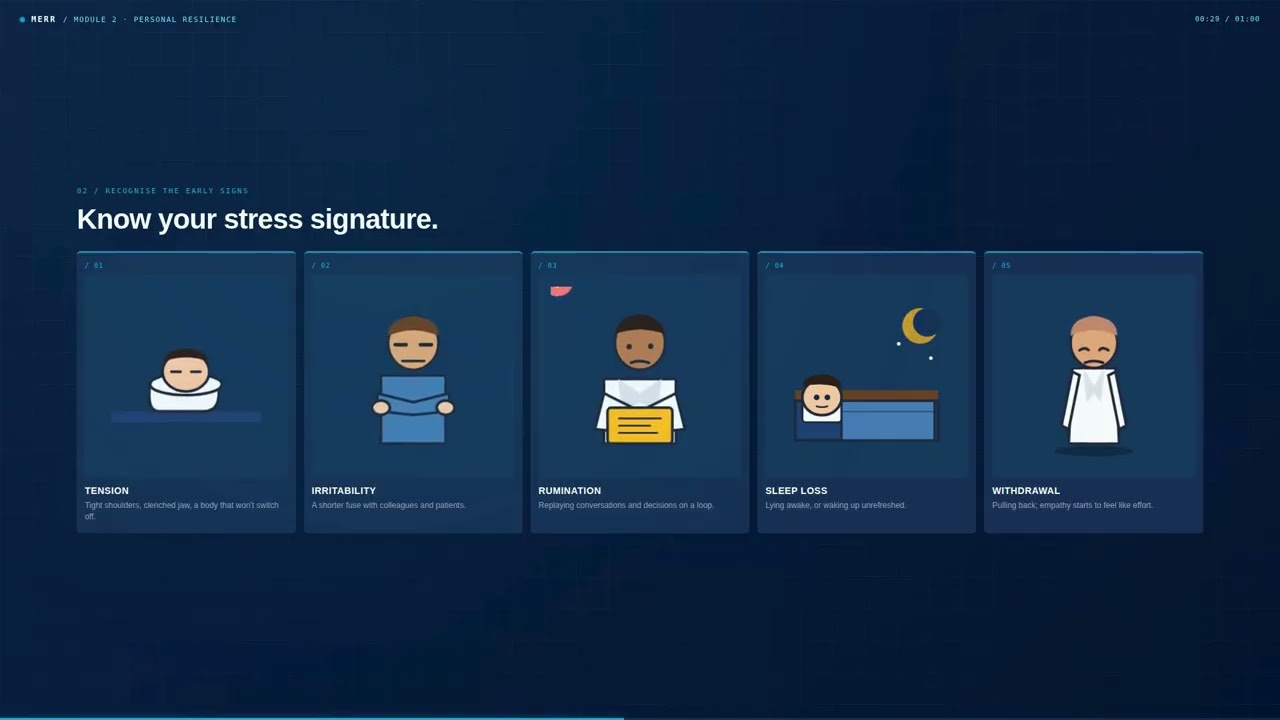
The session focuses on practical emotional regulation tools, early warning signs, and boundary-setting skills that can be applied during shifts. Participants develop a realistic, role-sensitive self-care plan supported by a digital self-care planner. Through case discussion, peer exchange, and guided reflection, the module promotes resilience not as endurance, but as adaptive recovery capacity.
The aim is not to individualize systemic problems, but to strengthen coping skills while recognizing structural responsibility.
-
3
 Assessment 2This module requires practical application through structured assessment activities. Healthcare professionals must demonstrate competency through evidence-based evaluation methods that translate theoretical knowledge into protective practice.
 -
4
 Pilot Assessment
During the pilot sessions, the learning outcomes are assessed through a blended portfolio of practical methods. Each method specifies the activity participants complete, the evidence a trainer collects for the micro-credential portfolio, and the learning outcome it maps to.