Module 6: Stress Management and Burnout Prevention for Nursing & Nursing Assistants

- Description
- Curriculum
- Reviews
Burnout among nurses and nursing assistants is increasingly recognized as both an occupational and organizational challenge within healthcare systems. Continuous exposure to high workload, emotional demands, staffing shortages, time pressure, and rotating shifts creates sustained stress that directly affects staff wellbeing, retention, performance, and patient safety.
This module focuses on how burnout develops within the realities of nursing work and how practical prevention strategies can be integrated into daily clinical routines. Particular emphasis is placed on the interaction between emotional labour, workload intensity, recovery limitations, and organizational conditions.
A central framework in this module is the understanding that burnout emerges when prolonged job demands exceed available recovery resources and coping capacity over time. Effective prevention therefore requires not only individual resilience strategies, but also safer communication cultures, supportive teamwork, realistic workload management, and early recognition of overload signals.
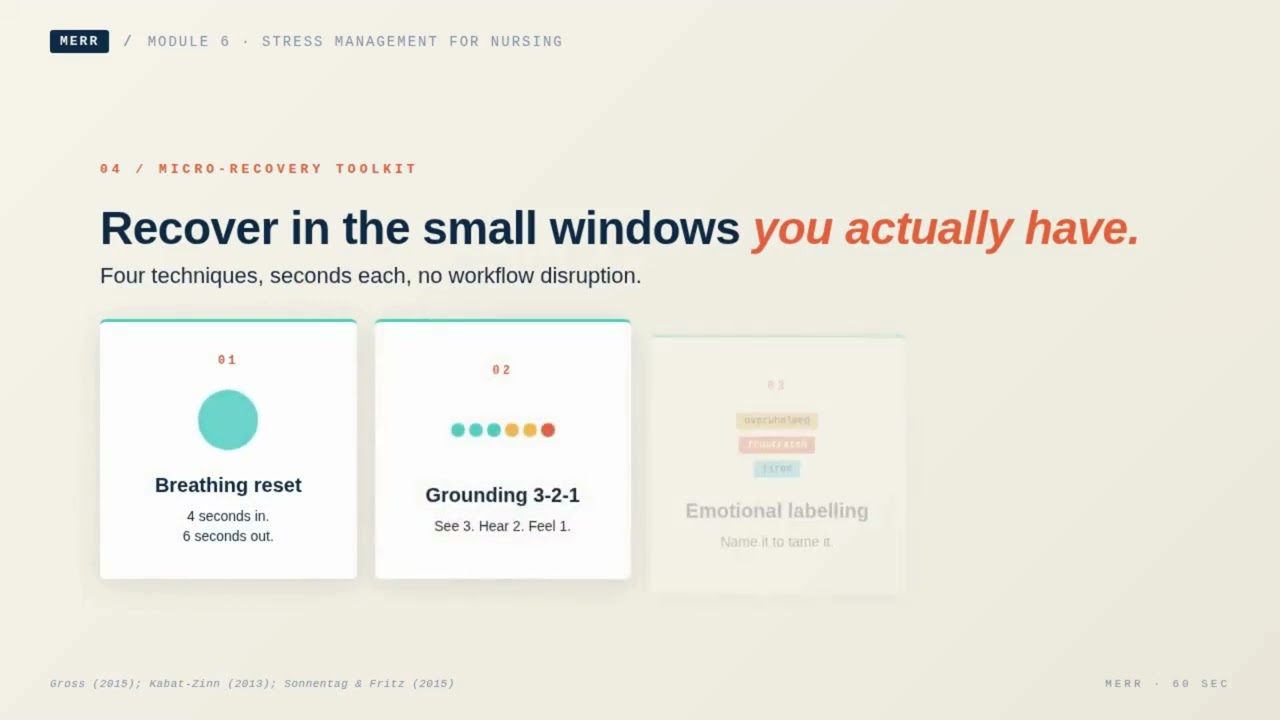
The module emphasizes realistic and scalable interventions adapted to nursing environments, including:
● micro-recovery techniques during shifts,
● emotional decompression practices,
● peer support routines,
● workload reflection tools,
● escalation pathways,
● and structured self-monitoring strategies.
Ultimately, burnout prevention is presented not as an individual responsibility alone, but as part of a broader culture of psychological safety, team resilience, sustainable nursing practice, and quality patient care.
-
2
 lesson 1: Theoretical Background and Nursing Burnout Models
Burnout is recognised by the World Health Organization (WHO, 2019) as an occupational phenomenon resulting from chronic workplace stress that has not been successfully managed.
In nursing environments, burnout develops through prolonged exposure to demanding working conditions, emotional labour, workload pressure, and insufficient recovery opportunities.
Two theoretical frameworks are particularly useful for understanding burnout in healthcare:
• The Maslach Burnout Framework
• The Job Demands–Resources (JD-R) Model
These frameworks form the foundation for the practical exercises and case studies presented throughout this module.
Unlike short-term stress reactions, burnout develops progressively through chronic exposure to demanding working conditions that exceed available physical, emotional, and organizational resources over time. In nursing environments, burnout is associated with emotional exhaustion, depersonalization or emotional distancing, reduced professional efficacy, increased absenteeism, reduced job satisfaction, and higher turnover intention. Importantly, burnout also affects patient outcomes through increased risk of errors, communication breakdowns, reduced empathy, and decreased quality of care.
From a systems perspective, burnout in nursing should not be understood as an individual weakness or inability to cope. Instead, it reflects the interaction between high job demands and insufficient organizational support, staffing, recovery structures, and psychological safety. Modern burnout prevention approaches therefore emphasize both individual resilience and organizational responsibility.
-
3
Lesson 2: Structural, Emotional, and Organizational Contributors to Burnout
Building on the theoretical models presented previously, burnout in nursing can be understood through three interrelated categories of workplace influences: structural, emotional, and organisational contributors.
The following section translates the theoretical concepts into practical workplace realities commonly experienced by nurses and nursing assistants.
Understanding these three categories is essential for designing effective burnout prevention strategies because each represents a different layer of influence within daily nursing practice.
-
4
Lesson 3: Practical Application and Training Activities
This section translates theoretical concepts into practical nursing applications. The focus is on recognizing overload early, mapping stress patterns, strengthening emotional regulation, and applying realistic prevention strategies during clinical work.
Participants are encouraged to connect the activities with their own workplace experiences and nursing environments.
-
5
Lesson 4: Boundary Script and Escalation Practice
Scenario Examples
● A relative demands immediate attention during medication administration.
● A nurse is asked to accept additional unsafe workload.
● A staff member hesitates to escalate fatigue or overload concerns.
-
6
 Assessment 66Assessment and Implementation Framework This module requires practical application through structured assessment activities specifically designed for nursing and nursing assistant contexts. Healthcare professionals must demonstrate competency through evidence-based evaluation methods that translate burnout prevention theory into protective nursing practice.
 -
7
Pilot Assessment
During the pilot sessions, the learning outcomes are assessed through a blended portfolio of practical methods. Each method specifies the activity participants complete, the evidence a trainer collects for the micro-credential portfolio, and the learning outcome it maps to.