Module 8: Administrative Staff. Resilience in Healthcare Support Roles

- Description
- Curriculum
- Reviews
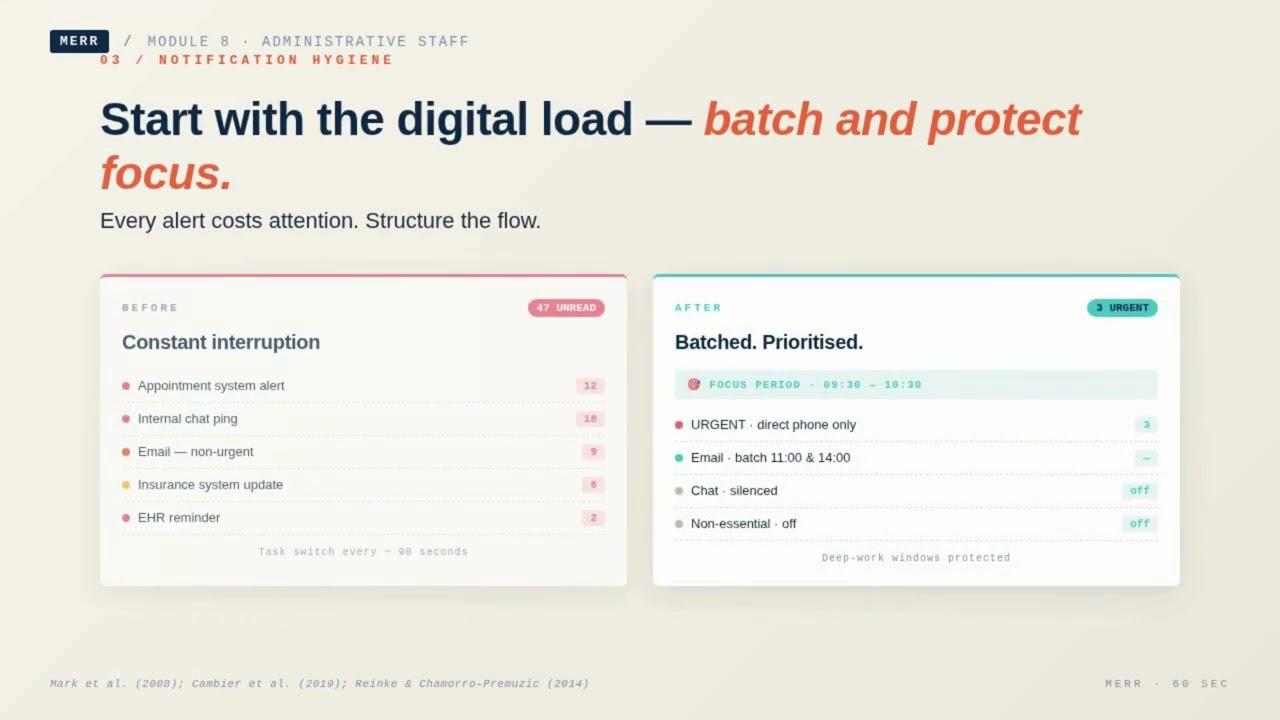
Administrative staff in healthcare settings play a critical structural and relational role at the interface between clinical services and patient access. This domain covers the identification and management of front-desk stressors, primary prevention strategies for service-role professionals, digital notification hygiene and workload management, policy literacy and procedural confidence, rights awareness and escalation pathways, and the integration of individual and organisational resilience approaches for sustainable well-being.
Administrative staff in healthcare play a crucial role at the interface between patients, clinical teams, and institutional systems. Working at reception desks or in administrative coordination often involves managing high patient flow, time pressure, emotionally demanding interactions, policy constraints, and multiple digital demands. These pressures are not merely individual challenges; they are embedded in service roles and can contribute to chronic stress when not addressed effectively.
This module focuses on primary prevention strategies that help administrative staff manage daily demands before they lead to overload or burnout. Participants explore front-desk stressors, emotional labour, notification hygiene, policy essentials, and escalation pathways. The module emphasizes both individual coping skills and organisational structures, including clear role boundaries, supportive leadership, and practical escalation procedures.
Through peer-coaching, case-based reflection, multiple-choice assessment, and follow-up activities, participants develop practical strategies to maintain professional communication, reduce digital interruptions, and seek support when workplace demands exceed their role or available resources.
Module Delivery Specifications
Duration: 80-90 minutes live session plus optional 15-30 minutes self-study phase.
|
Duration |
Module component |
|
5 min |
Opening and framing |
|
20-25 min |
Condensed theoretical input: front-desk stressors, primary prevention, emotional labour, notification hygiene, policy essentials, rights and escalation |
|
10 min |
Practical Exercise: Peer-Coaching |
|
15-20 min |
Scenario Exercise: case vignette and structured reflection questions |
|
10 min |
Peer Reflection Questions |
|
10 min |
Comprehensive Assessment: Multiple Choice Evaluation |
|
10 min |
Transfer and follow-up planning |
|
80-90 min |
Total live-session duration |
Optional split: The module can be divided into two 40-45 minute sessions. Session 1 covers opening, theoretical input, and peer-coaching. Session 2 covers the case vignette, peer reflection, assessment, and transfer planning.
-
3
 Assessment 8This module requires practical application through structured assessment activities. Healthcare administrative professionals must demonstrate competency through evidence-based evaluation methods that translate front-desk resilience theory into professional practice.
 -
4
 Pilot Assessment
Practical Exercises
The following activities use the required exercise structure so that each task is explicitly linked to the learning outcomes and can be implemented consistently by facilitators.